How I'm building an iOS app with a team of AI agents
Last updated

Antonio Ufano
Lately I've been working on a new side project, an iOS app, but to be honest the app is not the main goal, just an excuse to experiment with AI tools and learn to set up processes, automate work and use these tools to be as fast, reliable and efficient as possible, both as an engineer and as a product person. Basically, I want to find out how close I can get to 10x (or 100x 😅) my output. And the best way I know to learn something is to build something real with it.
The app is simple: it tracks the protein you eat. You say what you ate, an LLM estimates the protein, and you see how far you are from your daily goal. I built it for myself and shared it with my gym colleagues, so they were also my first testers.
To build it, I ended up with a small org of AI agents. It didn't start like that, it grew step by step, so in this article I'm going to explain how it grew, the tools I used, what I've learned, and how you can build a first version of this setup yourself. This is a first step, and probably the first post in a series. Let's see...
Introducing the Tech Lead
Before any agents, I was using Codex (and sometimes Claude) like most people do: I descrived some features, it turned them into tasks, worked on them, opened a pull request, I reviewed it, and then I moved to the next one. One task at a time, sometimes a few in parallel. It worked, but I wanted to go one step further, so I installed Grok Bot and created my first agent, a Tech Lead. I described the app and together we came up with the whole architecture, tech stack etc. Then it created all the tasks, split them into milestones and started working on them in parallel.
At this point I was still the product person, deciding what to build, and the Tech Lead ran the engineering work. The Tech Lead launched separated Cursor cloud agents (running Grok 4.7 or Composer 2.5) to work on the engineering tasks, one agent per issue, each one opening a pull request. Then the Tech Lead itself reviewed the PRs.
The Tech Lead never merges without my yes. For example, one of the coding agents opened a PR that replaced the raw server error messages with friendly, translated ones, with all CI checks green. The Tech Lead checked the diff and then asked me if it should merge it. That's exactly how I want it at this time.
The weak point of this first version was the cost. I ran out of credits twice as both Cursor agents and Grok agents share the same subscription and token pool, so I decided to give the Tech Lead its own Claude subscription, which changed how the coding part works (more on that in the tools section).
Expanding the organization with Product Lead
The Tech Lead was very good at planning and doing tasks, but only from an engineering point of view, with no product goals behind the work. So at the end of October I added a Product Lead above engineering, to own the "what" and the "why" and leave the "how" to the Tech Lead. We discussed the goals of the product, the target audience, etc. What happened next is the part that made me want to write this article:
- The Product Lead introduced itself to the Tech Lead and asked for a full status of the product: what's built, what's in progress, stack, users, blockers... and added "please don't start anything new for now".
- The Tech Lead replied with a structured status, including the constraints I had set, and ended with "I won't start anything new until you send a brief".
- The Product Lead sent back a first brief, with a clear scope, an explicit out of scope (Pro features and payments) and a "done means" line.
- The Tech Lead turned that into a plan and got to work.
All of this happened in a few minutes, with written messages between agents. From there, the Product Lead and I expanded the product goals for the app:
- Internal testers first. My gym colleagues on TestFlight, and the real test is whether they log their meals every day for two weeks.
- Measure retention from the start, with simple numbers like daily active loggers and D1/D7/D14 retention.
- Test the price before building Pro. The hypothesis is €4.99/month or €29.99/year, and the plan is to show a few "coming soon" Pro features to see if people actually want them.
- Get the first paying users, with a first target of about €500/month in recurring revenue. It's a side project for now, not a startup.
Since then, most of the engineering work starts with one of these briefs: one brief gets one plan, one build and one PR, and every PR says which agent and model wrote it. The Product Lead reviews those PRs too.
On top of that, the Product Lead started to run a daily standup for me, and it always ended by asking me what I would take on that day. A small thing, but it made me commit to my own part of the work, not only review what the agents did 😉
And then a Chief of Staff
With two leads I had a new problem. I was talking with the Tech Lead and the Product Lead separately, and each one worked on things the other didn't always know about, so sometimes they didn't have enough context. What I wanted was a single point of contact, so I added a Chief of Staff agent.
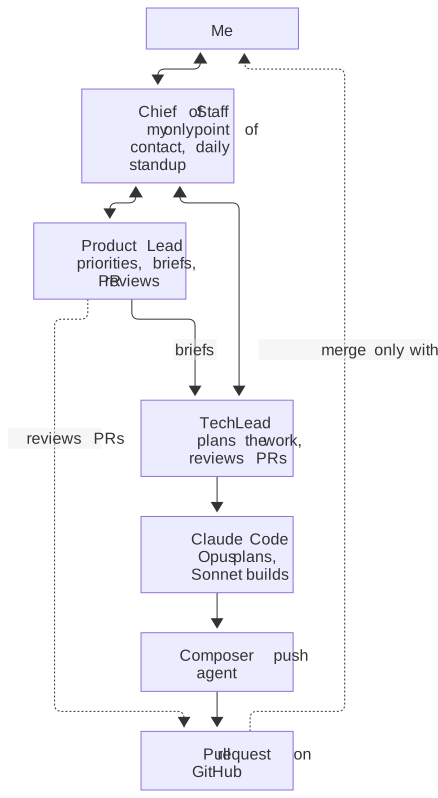
It owns the daily standup now, every weekday morning at about 9:00. Before it, the Chief of Staff collects the updates from the Product Lead and the Tech Lead, and then it sends me one message with the progress, the blockers, anything related to money, and the decisions that only I can make. From now on, I only talk with the Chief of Staff.
The leads still do their deep work in their own areas, and approvals for merges, deploys and things like that still need my own yes. The difference is that everything reaches me in one message, and both leads report to the same agent.
This is how the team looks today:
I had been using this structure for a couple of weeks when Brian Armstrong, the CEO of Coinbase, posted on X that he has one lead agent per area of focus and a chief of staff agent "that oversees them". It was nice to see someone like him landing on the same structure 😅
The tools
There are two main tools behind this setup:
- Grok Bot: it runs the whole orchestration. The Chief of Staff, the Product Lead and the Tech Lead are agents there, each one with its own chat and memory, and they send messages to each other. So far, it's the only tool that has let me run this kind of setup super easily, although Dots (by OpenAI) or a Claude alternative might change that.
- Claude Code: it runs on the Tech Lead's own computer and does the coding. I have a fixed rule for the models: Opus 5.5 only writes a detailed plan, Sonnet 5.5 builds the code and runs the tests by default, and a small Composer 2.5 cloud agent only pushes the change and opens the PR.
How to build your first version
If you want to try this, here is how I would start:
- Start with one agent. A Tech Lead with access to your repo is enough. Give it a short role description: what it owns, your constraints, and what it can't do without you (merge, deploy, spend money).
- One task, one plan, one PR. Ask it to write small issues with acceptance criteria before any code is written, and use a stronger model to plan and a faster one to build.
- Review and merge yourself. CI green is not the same as "this is what I wanted", so read the PRs.
- Add a level only when you feel the pain. When you notice that nobody owns the priorities, add a Product Lead that writes briefs with scope, out of scope and a "done means" line.
- When you're following too many chats, add a single point of contact. A Chief of Staff that collects the updates and sends you one daily message with progress, blockers, money and the decisions you need to make.
Where the app is today
As of today, the app is in TestFlight with around 10 people testing it so far. Recent builds added a new design, better voice input and a 7-day history. And it has 0 paying customers, so this is not a success story yet, just a "how it's going" one 😅
Conclusion
This is not a finished setup. It made me very productive with very little setup and an easy learning curve, but tools and LLMs change from one month to the next, so nobody knows how this will look in 3 or 6 months, including me. This is a first version that works for me now, and I'll post updates here as it changes, so stay tuned 🤓
If you enjoyed this article consider sharing it on social media or buying me a coffee ✌️

Oh! and don't forget to follow me on Twitter where I share tons of dev tips 🤙
my projects
Apart from writing articles in this blog, I also enjoy working on personal projects.

theLIFEBOARD.app
theLIFEBOARD is a weekly planner that helps people achieve their goals, create new habits and avoid burnout. It encourages you to plan and review each week so you can easily identify ways to improve your productivity while keeping track of your progress.
Sign up
SolidityTips.com
I'm very interested in blockchain, smart contracts and all the possiblilities chains like Ethereum can bring to the web. SolidityTips is a blog in which I share everything I learn about Solidity and Web3 development.
Check it out if you want to learn Solidity
Quicktalks.io
Quicktalks is a place where indie hackers, makers, creators and entrepreneurs share their knowledge, ideas, lessons learned, failures and tactics they use to build successfull online products and businesses.
Watch some interviews